
Passenger Pigeon

(Ectopistes migratorius)
Among recently extinct North American birds, the passenger pigeon is perhaps the most famous. Its story has become a classic example of how even the most abundant species can be driven to extinction through human actions and a powerful reminder that what seems plentiful today is not guaranteed tomorrow.
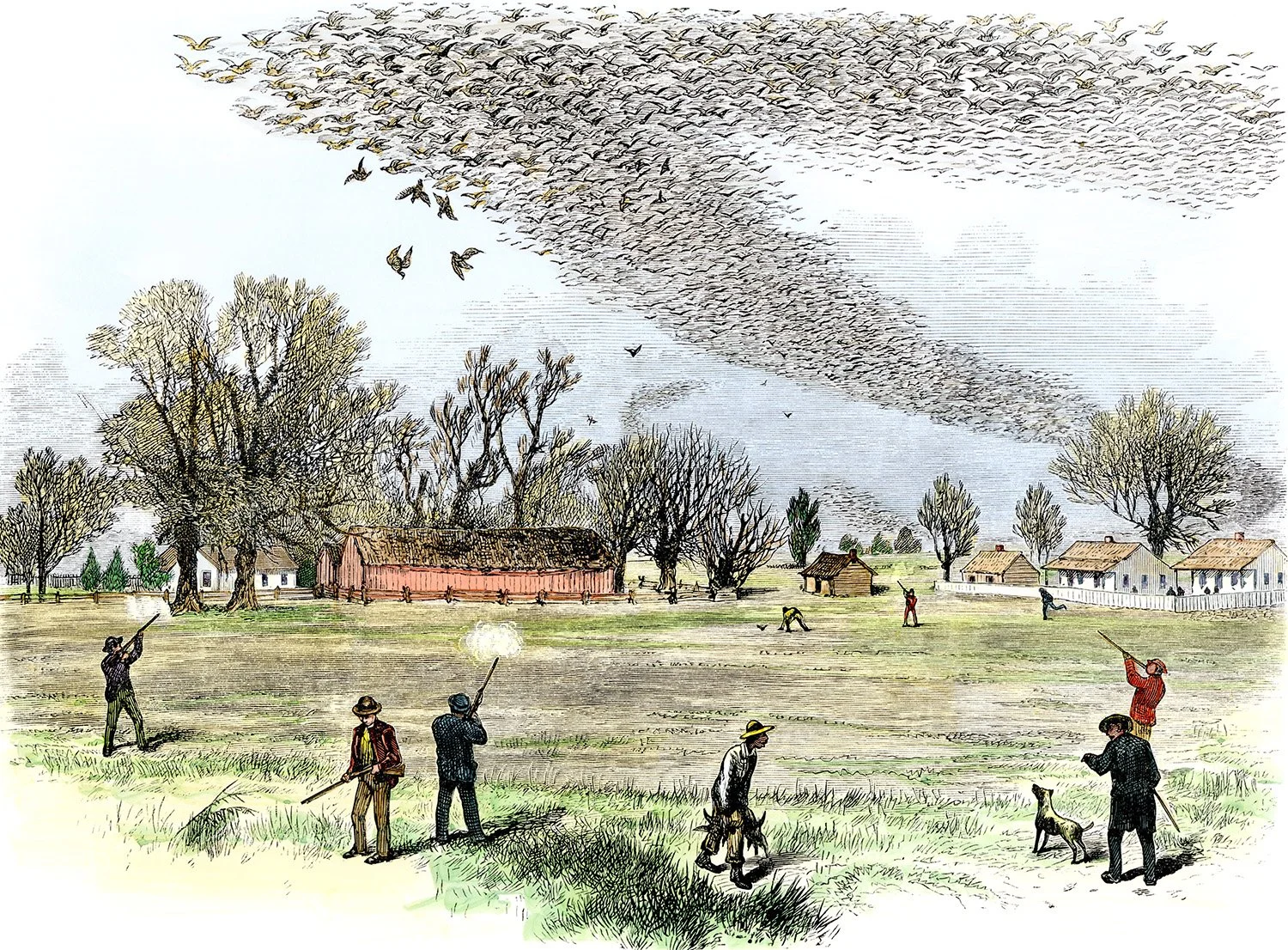
The passenger pigeon may have been the most numerous bird on the planet, with population estimates ranging from 3 to 5 billion individuals. Historical accounts describe flocks so large they darkened the sky and took hours to pass overhead. Their range spanned nearly all of the United States and southern Canada east of the Rocky Mountains. They formed enormous breeding colonies, the largest recorded covered about 850 square miles. These gatherings profoundly shaped their environment, their droppings enriched the soil, and the sheer number of birds provided abundant food for predators of all sizes, from hawks, mink, and raccoons to wolves, bears, and cougars, all taking advantage of the easy prey. Given their staggering abundance, it is almost unimaginable how quickly their fate would change.
After European colonization, passenger pigeons became an important food source, especially for people living on the frontier. By the early 1800s, hunting had become commercialized, and large-scale market hunting took off. The birds were so abundant that hunters could simply fire into massive flocks and be sure of hitting several at once. They were also trapped in large numbers, with thousands captured at a time. Nesting colonies were heavily targeted. Hunters would use long poles to knock nestlings from trees or simply cut down the entire tree. At some nesting colonies, as many as 50,000 young birds were killed per day for months on end. At the time, hunters believed the species was so numerous that nothing they did could possibly make a difference.
By the 1870’s, it had finally become clear that passenger pigeons were in rapid decline, and efforts were made to save the species. Protests arose, and laws were passed to curb hunting, but these protections were widely ignored. By the 1890’s, the bird was nearly gone from the wild, and the last confirmed wild individual was shot in Illinois in 1901.
Because the species had once been considered too common to bother with, zoos and aviaries had shown little interest in keeping them until it was nearly too late. In the 1890’s, when the species’ collapse became undeniable, the few remaining captive birds were brought together in hopes of breeding them, but those attempts were largely unsuccessful. By 1910, only one bird remained, a female named Martha at the Cincinnati Zoo. She lived there for four more years before dying in 1914 at the age of 29, marking the extinction of the species.
Today, the passenger pigeon stands as one of the most sobering conservation lessons in history. Its extinction underscores how quickly even the most abundant species can vanish when exploitation goes unchecked. The story of the passenger pigeon continues to shape modern wildlife protection efforts, reminding us that awareness and action must come before it’s too late.

Photo of Martha, the last passenger pigeon at the Cincinnati Zoo.