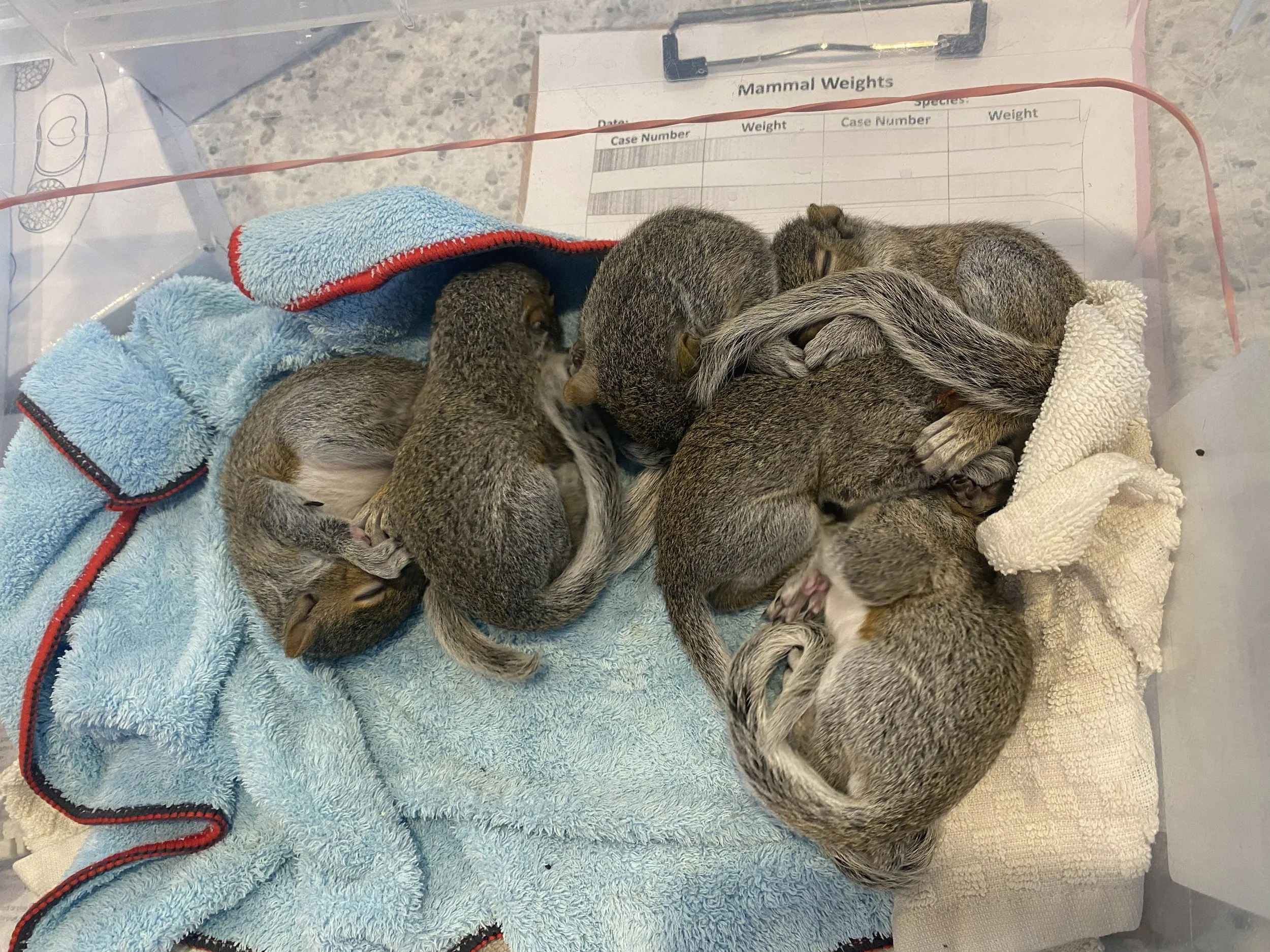
By Jan, Aark Volunteer

Here at Aark we are just beginning baby season. Orphaned tree squirrels, particularly the eastern gray squirrel, are our most common admission both in the spring and fall season. Last year (2025), we cared for 1,394 orphaned and injured gray squirrels at the Aark, plus 64 flying squirrels and 8 red squirrels. We are grateful to you, our community, for caring enough to bring us all those squirrels in need!
Eastern gray squirrels are 12 to 15 grams at birth, hairless, completely helpless, and ridiculously cute! Meaning well, sometimes people see this vulnerable creature and decide to care for it and raise it as a “pet”. Unfortunately, this usually does not end well. For example, we had a young squirrel admitted, brought in by someone who had tried to care for the orphan squirrel at home. They found it under a tree at approximately four weeks old. When admitted, the young male squirrel was fully furred, eyes open, feisty, and 16 weeks old. They brought him to Aark because he was becoming increasingly aggressive and had attacked a family member.
This is not uncommon. Newborn squirrels are extremely cute, but within three short months they are fully weaned, independent, and territorial. In the wild, their innate behavior and physical abilities are solely geared toward their survival. They have an excellent sense of smell, hearing, and sight. Their claws are strong with sharp needle-like nails to help them leap from branch to branch. Gray squirrels can rotate their rear leg ankles 180°. They can run down a tree as fast as they can run up! This unique physical characteristic also allows them to hang from branches, and sometimes bird feeders, to obtain food. Squirrels have powerful jaws and teeth. Their sharp incisors continually grow and allow them to crack the hardest of shells and seeds. Squirrels use their extraordinarily muscular bodies, agility, sharp teeth, and claws not only to forage to obtain food, but also to fight and defend their nest and food stash.
All these remarkable physical and behavioral characteristics that help squirrels to survive in the wild are the very reason they do not make good pets. Sweet, helpless, and precious baby squirrels grow into energetic, active, and unpredictable juveniles. Their powerful jaws and ever growing front teeth can gnaw through wood and plastic, and when in captivity that may include curtains, furniture, carpeting, wires, and most barriers. Their razor sharp claws and propensity to run, jump, and climb means the entire house becomes a playground. In the wild, squirrels only seek companionship or affection for mating and so often become aggressive toward caregivers. They are easily startled and will not hesitate to defend themselves if they perceive danger.
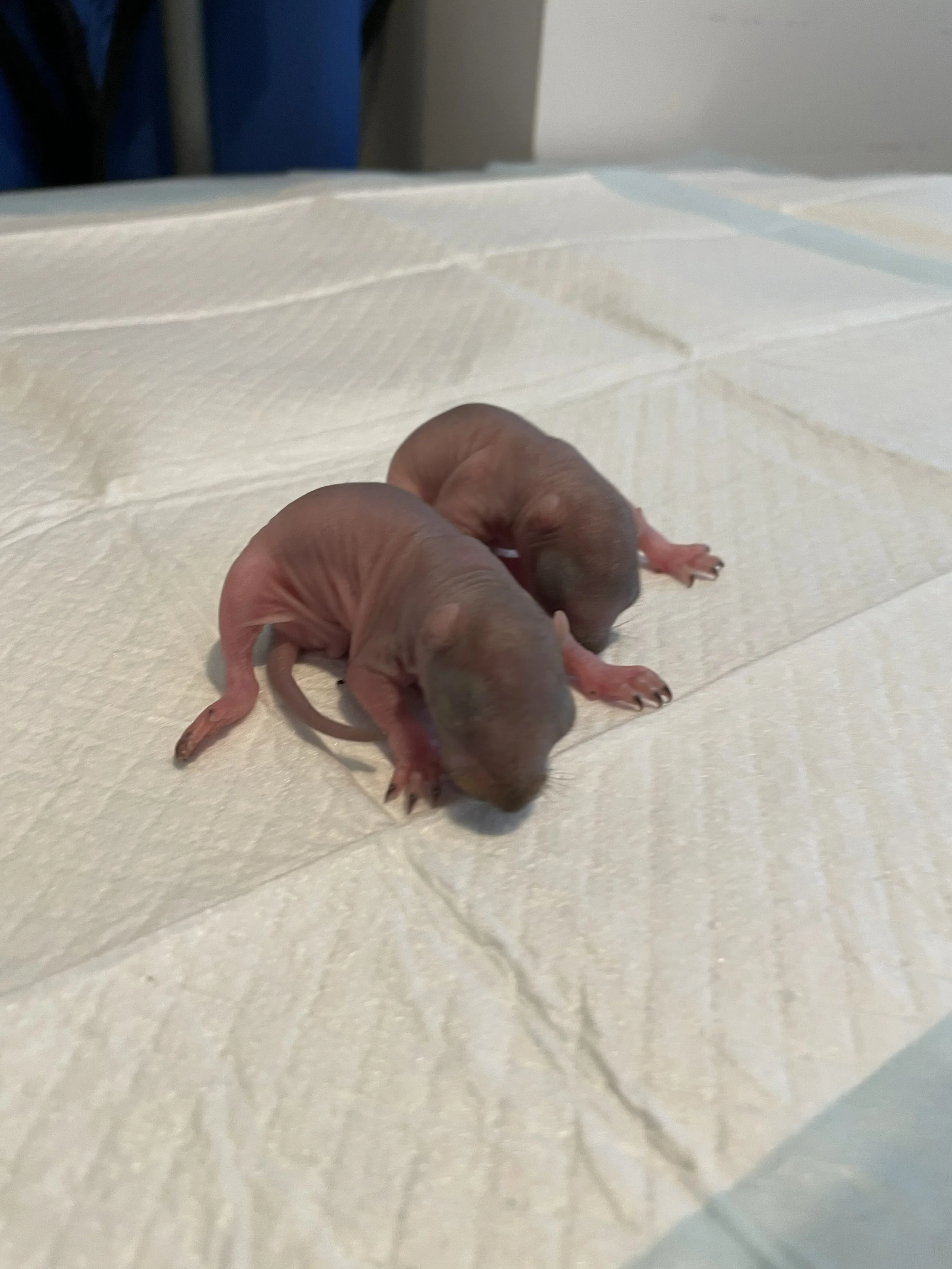
Raising squirrels becomes more complicated because nursing babies requires specific formulas to enhance their bone growth and overall health. More importantly, their nutritional requirements change as they grow and mature. What to feed, how to feed, how much to feed, and how frequently to feed are ever-changing issues when caring for baby squirrels and depend on their level of health, maturity, and ability to gain weight. Babies under three weeks of age have different fat and protein ratio needs than a weaning squirrel three weeks and older.
Squirrels continue to have particular dietary demands even with the introduction of solid food. When a squirrel's dietary needs are not met, it affects their health, more specifically their bone development. People associate squirrels with nuts, and yet in the wild they also ingest a varied diet which may include native seeds, fruits, fungi, grains, vegetables, sometimes the occasional potted plant. In small amounts nuts are fine, but when a young squirrel's diet consists of mostly nuts and is deficient in other foods, they can develop Metabolic Bone Disease (MBD). MBD is caused by insufficient calcium absorption which results in the weakening of the skeleton and joint abnormalities. Many nuts contain high phosphorus levels which block calcium absorption. MBD is mostly associated with animals raised in the home of well-meaning people and is rarely seen in the wild. Among other signs and symptoms, the juvenile squirrel will show weak muscles, brittle bones, joint deformities, muscle tremors, and possible seizures. Unfortunately, what we often see at the Aark is the admission of young squirrels raised at home with a sudden inability to use their back legs. Usually, it is related to some sort of fracture due to the fragility of the bones. Once these changes occur it is difficult and sometimes impossible to treat.
When a person finds a baby squirrel, the first instinct is to consult the internet or possibly a pet store as to its care. These resources usually give overly simplistic and sometimes wrong advice. Some of the formulas recommended often cause diarrhea and bloating which can lead to death. Sometimes it is possible to reunite the squirrel with its mother which gives the baby the best possible chance for survival. If you find a baby squirrel, here are the steps to follow:
1. Check for injuries.
If the baby has visible wounds, is bleeding, is covered in flies or maggots, or was caught by a cat or dog, it needs immediate help from a wildlife rehabilitator. Place the baby in a small box with a soft cloth and contact a licensed wildlife rehabilitation center right away.
2. Determine if the baby truly needs help.
Very young squirrels (pink, hairless, or eyes closed) should not be on the ground and likely fell from the nest. Older squirrels that are fully furred with open eyes and a fluffy tail may simply be learning to explore and may not need intervention.
3. Try to reunite the baby with their mother.
If the baby appears uninjured, place them in a small container such as a shallow box or basket lined with soft cloth and supplemental heat. Secure the container to the tree where the baby was found or place it at the base of the tree. Then leave the area and observe from a distance. The mother will not approach if people or pets are nearby. Mothers typically return within 1–3 hours to retrieve their baby.
4. Keep the baby warm while waiting.
Baby squirrels cannot regulate their body temperature. If the baby feels cool, place a warm (not hot) water bottle, hand warmer, or heating pad set on low under half of the container so the baby can move away if needed.
5. Do not feed the baby.
Feeding the wrong formula or feeding incorrectly can be dangerous and life threatening for baby wildlife. It’s best to wait for professional guidance.
If the mother does not return after 1-3 hours, or if the baby appears weak or injured, contact a licensed wildlife rehabilitation center for assistance. At the Aark, we have the resources and experienced staff to take care of squirrels at all ages. Every year we release hundreds of healthy, independent juvenile squirrels. Therefore, if you find a baby squirrel, please keep it warm and call us immediately.
Again, we thank those individuals that have cared enough to bring us animals in need and to support us as we endeavor to help one baby at a time. For baby squirrel videos and education follow us on social media @aarkwildlife